Hey, the simple truth of the matter is that people die of cancer. When you're in the survivor battle it can be hard to verbalize this. We tend to have this "let's not talk about the bad stuff, because talking about it makes it real, gives it power, scares us, etc." So we frequently focus on the positives, give all our cancer survivors hugs and positive encouragement, chant the mantra that we can create our own reality and sweep the scary stuff under the rug. But today I got the privilege of talking with a couple of folks that are staring their mortality straight in the face, and doing it with a calm grace that was truly inspiring to watch.
The first person is an elderly woman, in the infusion center to get platelets. Normal platelet count is 150-400 and you can walk around with a platelet count of 80 and in general be ok. Her platelet count was six. At 15 they give you a platelet transfusion. So she is basically a train wreck waiting to happen. Brain bleeds, internal organ leakage - nasty stuff. You really need platelets to do what you'd like to do - like walk around without having your organs bleed internally. So you'd expect this woman to be super stressed, or terrified or something. But no. She just walks in (carefully, because if you bruise yourself when your platelet count is six, you are some kind of fucked.) Sits in the chair, gets hooked up, calm as can be and sucks up the life giving platelets. And oh yeah, she has an incurable blood disease and will be dead in six months. And her daughter is with her, bemoaning how the universe can allow someone to hit and run her car while she's transporting her dying mother to the infusion center. But through all of this, these people are as nice as can be - loving to each other, finding ways to laugh at all the little things in life that you have to deal with to live in the modern world. All the time looking down the barrel of the mother's imminent demise. It's just so amazing to see people cope with this kind of mortal threat with dignity, grace and loving approach. When you talk to them, your efforts to help seem so puny and useless given everything they're going through. But as a social worker told me, we give them a gift when we stand witness to their journey. So my pillow plumping and warm blanket wrapping may not have been much, but I was there (after a 2 hour commute in the snow) and it really felt like an honor.
The next guy is an old Russian. And he just looks like a zombie. I mean, really. He's old, yellow skin, skinny to the point of looking like someone from a concentration camp. He got three bags of red blood cells the day before. At the nadir of my treatment, I got two bags one day and it made me look and feel great. But he had three bags and still looked horrible. So you can imagine what he looked and felt like before he got his transfusion. And here is the dialog he has with the nurse:
"How are you feeling today?"
"Good!" (which is hard to believe, given his obviously whacked out blood chemistry and extremely low weight). "I was a bit tired, but better today. " Translation - if you need three pints of red blood cells, feeling a bit tired is a code word for being flat on your back, unable to move due to a complete lack of oxygen delivery capacity.
"How are the sores in your mouth?"
"Still there a bit, but getting better every day."
The nurse asks him several more questions and although he's not evasive, it's pretty clear that he's just not going to admit to anything really bothering him. And he does it all with a calm, dignified demeanor. Although I don't know the details of his prognosis, he's in WAY worse shape then when I saw him a month ago. If it was Vegas, I would bet heavily that he'll be dead in a month or two.
It's kind of a freaky thing to be in the presence of dying people. Somehow you think they should be wailing or shouting or paralyzed by their fear of dying. But in general, they just kind of look and act like you or me. Granted, they usually look pretty messed up but I've been amazed and impressed that these people manage to keep it together. Of course, they may be doing a lot of screaming and moaning and wailing in private but when I see them in the infusion center, their behavior is really a testament to the strength of the human character. They may not look like much to the casual observer, but I've gotten to know them enough to see the hero and heroine inside. It's an honor to get them a pillow and a blanket and maybe share a story or two.
That's the report from the infusion center. Just wanted to share the powerful things that go on in such a place while the rest of us stress out about whether our favorite football team wins on Sunday or what kind of dressing we'll prepare for our Thanksgiving dinner. Intense stuff, for sure. But rewarding to be able to witness.
Thursday, November 21, 2013


Thursday, November 14, 2013
Geo on video!
This summer, I had the opportunity to participate in a video for Patient Power, a web site that provides information to patients about a range of health issues. It was really fun - we filmed for about three hours and talked about my cancer experience with a few folks from my care team. I never met a camera I didn't like! So if you want to hear me talk about my cancer journey with an emphasis on the recurrence phase, check out the links below.
- Talking about my initial cancer diagnosis
- More discussion about my recurrence
- Some pretty personal thoughts about dying, life - reexamining your life after a diagnosis of a recurrence
another good doctor's visit! A healthy fall with lots to be thankful for
Howdy, all! Today I had another six month check with my oncologist and everything is still going well. So - yeah! I've been meaning to post for a while but thought I would wait to get through this visit and summarize how things are going for me. Here's the latest stream of consciousness on my health. If you know me personally and are just checking up or you found this through a web search, I hope this is interesting. If not - well, close that browser tab and go out for a bike ride! Ok, in no particular order, here we go:
- Lots of things are still getting better slowly:
- Lung function. Definitely better. Over the last few months I've basically stopped thinking about my lungs. They just feel normal. I haven't had a PFT in quite a while so I don't have quantitative data, but qualitatively, things are better. Less coughing in the morning, less tightness in my chest when I get up to higher elevations, no wheezing. It's been over 3 years since I had the interstitial pneumonitis (brought on by Bleomycin toxicity) and it seems like the lungs are still healing.
- Peripheral neuropathy in my feet is less noticeable. Still there but less obvious than in months past. I'd like to start ice skating and playing hockey again and see how my feet do. Maybe this winter and next spring respectively for those two events.
- Left arm is working better. I can now swim 800 yards and use my arm pretty regularly. By the end of 800 yards of freestyle my hand has a definite purplish tint so I have still have some problems with delayed blood flow, but again, seems to be better. As the days get shorter and colder, I think I will start swimming more. The only negative is that in the dry Colorado winter air, being in a chlorine pool a lot definitely is hard on your skin so I'll have to be better about applying lotion than I have been. The side effect is dry, itchy skin and since itchy skin can be a Hodgkin's B symptom, I definitely don't want to do anything to cause that symptom, less I get my hypochondria dialed up and start stressing about a relapse.
- Things not getting better:
- Blood chemistry. Hemoglobin is getting a little better (13.1 today) but hematocrit is still about where it was last May (~38). That sucks. I love riding my bike hard and running hard and both are pretty painful when you're anemic. I'm participating in a double-blind study for the use of Brentuximab vedotin in relapsed Hodgkin's patients that have had a stem cell transplant, but I'm pretty sure from my response that I got the drug. And one of the adverse effects of the drug is low platelet counts (mine is 115, low normal is 150). So my oncologist and I are thinking that my anemia and low platelets may be a side effect of the brentuximab jacking around my bone marrow. Another data point is that my red cell average size is still around 110%. This is a sign of immature red blood cells. My onc isn't worried and I'm really living a pretty great quality of life, so I'm going to try to be a bit more healthy in my lifestyle (more fruits and vegetables, less alcohol, fats and sweets) and give my body all the help I can to have healthy bone marrow.
- I have some intermittent, low grade chills. This is the most worrisome symptom since this can happen with lymphoma. But I'm also a bit temperature sensitive, so we're thinking I may have some thyroid issues at work. We took some blood for that today and we'll have results in a week or so. I don't have night sweats, not running any fever, no other 'B' symptoms so we think there's nothing serious going on. But it is one of those nagging things that can be stressful.
- Thin hair. My hair is definitely thinner than it was before. I'd like it to be thicker, primarily as another sign of health. The good news is that I have less grey hair! Anyway, I'm not going to do anything about this either, but it is another subtle sign that my body has been through a lot in the last few years.
- To CAT scan, or not CAT scan? I'm now far enough out from my transplant that I can have some flexibility in how frequently I get scans. The upside of a scan is that you can find problems early and early detection can help long term prognosis. The down side is that CAT scans give you A LOT of radiation and at some point, you start entertaining serious risk for radiation caused illness - leukemia, heart problems, etc. I've gotten a number of CAT scans in the last three years so today we decided that I would not do a CAT scan this month, but wait until next march and then do them for the next three years on an annual cycle, assuming that no other symptoms present themselves. So again, it's a bit of a crap shoot and you kind of worry that you might be sticking your head in the sand and give tumors another six months to grow in your body. Which is pretty much a disgusting thought. But if you get too much radiation, you will get sick. Mutations can cause malignant cells to be produced and it would be a really stupid move to get another cancer from doing so many diagnostic tests to detect a cancer that you don't have. Now that would be ironic - but not good. So that's the decision. If something bad shows up in march there will be a lot of anguish that we decided to go this way, but with no acute symptoms today, I feel comfortable with the decision.
that's it from here. I hope you're having a healthy fall and thx for checking in! Look for my next post where I will shamelessly post pointers to a video I shot this summer about cancer survivorship. ttfn!
Tuesday, May 14, 2013
Another clean CT scan - yeah!
Yesterday I went in for my 24 month post stem-cell transplant CT scan. Today I got the results - everything looks OK! Before every one of these I manage to hypochondriac my way into believing that there is all sorts of problems looming. So far, this has all just been me misinterpreting the various groans and false starts you get from a body that has been through 2 years of chemo and a stem cell transplant. So it looks like I'm doing pretty well - no signs of any problems with my lymphatic system. Yeah, me!
That's the big news - other than that, I've been basically just living life. I'm working hard to get fit and have been making some progress, although my blood chemistry isn't totally great. I'm still a bit anemic and I really feel it when climbing uphill on my bike in the mountains of Colorado. This may get better in time or this may be as good as it gets. On the bike I get a little angry and frustrated at times but whenever I apply some perspective, I'm really happy with where I am. A few other check points on my overall health:
So that's the quick update. To close, I'll post a fun note I sent to my oncology team today. I got a chance to do a fun obstacle course race with Kyle and Caitlyn over the weekend so I sent some photos to my oncology staff and thanked them for helping me return to a relatively normal, healthy life. I hope you enjoy the pictures and remember what you promised me 3 years ago - keep getting all your preventative checks - as bad as cancer is, it's WAY better to find it early than late. Early = treatable. Late = not so much.
----


That's the big news - other than that, I've been basically just living life. I'm working hard to get fit and have been making some progress, although my blood chemistry isn't totally great. I'm still a bit anemic and I really feel it when climbing uphill on my bike in the mountains of Colorado. This may get better in time or this may be as good as it gets. On the bike I get a little angry and frustrated at times but whenever I apply some perspective, I'm really happy with where I am. A few other check points on my overall health:
- My left arm still has some venous scaring - probably from the failed port I had in my chest 3 years ago. I went to a vascular surgeon and the only possible remedy now is some major thoracic surgery - remove a rib, pull out some chest muscle in an effort to increase the pathway for the major vein in my upper left arm and hope that it will expand a bit. No thanks! But my swimming is getting a little better - a few weeks ago I swam 800 yards of freestyle and although my hand was a little purple, my arm basically worked. This is a big improvement from last year when I could only swim about 200 yards before my arm really got tired and swollen.
- Had a cardiac stress test in March. I'm down about 8% in performance from 2009. Adjusting for age, this isn't bad. No signs of heart problems. Good news. I can hammer on the bike without fear of dropping dead from some undiagnosed heart condition.
- Had a PFT (pulmonary function test) in March. Also good news. I've got about 130% of predicted function for a guy my age. This is a good sign that the bleomycin toxicity I had in 2010 hasn't seriously damaged my lungs. Some days my lungs don't feel totally right but I have some tree pollen allergies and it's spring in Colorado so it could be some allergies. I'm deciding not to worry about this.
- As I mentioned, the big inhibitor to my performance (I think) is my red blood cell chemistry. Two issues here:
- My hematocrit is hovering between 38-41. Low normal is 40 and I used to be 46 so I'm down about 10-12% from what I was in 2009.
- My red blood cell average size is 110% of normal. This usually means that I have immature red blood cells - my understanding is that your RBCs shrink a bit as they mature so my guys are young and not as good at O2 transport as more mature RBCs. Hopefully this will get better over time.
So that's the quick update. To close, I'll post a fun note I sent to my oncology team today. I got a chance to do a fun obstacle course race with Kyle and Caitlyn over the weekend so I sent some photos to my oncology staff and thanked them for helping me return to a relatively normal, healthy life. I hope you enjoy the pictures and remember what you promised me 3 years ago - keep getting all your preventative checks - as bad as cancer is, it's WAY better to find it early than late. Early = treatable. Late = not so much.
----
Team – you all have diagnosed, treated and healed me over
the last 3 years, for which I will be eternally grateful. On Saturday, roughly
two years from my stem cell transplant and 39 months from my initial diagnosis,
I got my Christmas present from my two children – we ran a mud/obstacle course
race together outside of Glacier National Park in Montana (http://www.spartanrace.com/). In no
small part you are directly responsible for me being healthy enough to be a
Spartan Warrior! I thought you would enjoy these pictures:
Caitlyn, Kyle and I before the race:

Trying to get to the top of the rope obstacle:
Dammit, didn’t make it! So, 15 burpees:
Caitlyn and I leap the fire obstacle at the end of 5 miles,
900 feet of climbing, 38 obstacles of mud, climbing, crawling, rock dragging
and javelin tossing:
The happy warriors post-race:
Monday, January 14, 2013
Happy 2013!
Hey, all. I've been meaning to write for a while but have been busy with life. So here is a quick update to summarize the last few months for me:
As Susan posted in the fall, we've been pretty involved with LIVESTRONG so it's certainly been "interesting" to see how the fallout of Lance's activities on the bike are influencing LIVESTRONG. It's really a shame that all of this is going on because I think that LIVESTRONG is just a great organization. It helped over 13,000 cancer patients last year and raised over $38mm in funds to support cancer survivorship. Everyone I've met with LIVESTRONG has been really great and it's sad, frustrating and upsetting that the organization is being tarnished by all the doping that's gone on in cycling. I hope that the organization comes through in one piece - there are certainly lots of people in the world that need the services that LIVESTONG provides and I hope that it can continue its good work.
Well, that's a quick summary. Just wanted to let you know that in the world of cancer blogging, infrequent blogs are generally an indicator that we cancer survivors are out writing our bikes, drinking beer and enjoying life in general. Rock on!
- First and foremost, no sign of disease. Hell, yeah! I had my last CT scan in November and will have another one in February. All my CT scans in 2012 were clear so that's a good sign that things are going in the right direction.I'm still getting pretty nervous before each scan but each one has been uneventful.
- My overall fitness continues to get slowly better but it's been a very long road. In each of my CT scans my lungs still show some scaring from the bleomycin induced interstitial pneumonitis I developed in 2010. I'm also suspicious that I've had some COPD like symptoms develop from the BCNU I had as part of the BEAM protocol in March of 2011. I especially notice some funkiness in my lungs when I travel back to my home in Colorado (5400 ft) after working at sea level. For a few hours my lungs feel a little tight and I develop some sputum. I haven't had a PFT since September of 2011 and I suppose I could get another one. But from a quantitative perspective of how my bike and running workouts are going I'm still improving so I take that as in indirect sign that my pulmonary function is ok.
- The left side of my neck still doesn't feel like the right side. No new bumps and nothing on the CT scan that indicates a problem but I still get twinges now and then. I had nodular schlerosing Hodgkins which basically means I've developed some scar tissue in my lymph nodes. It's kind of a drag because every time I feel something at all out of the ordinary I instantly worry that I'm growing new tumors. But my neck has basically felt abnormal for almost 3 years now so I guess that's starting to be a new normal for me?
- My left arm is still a bit messed up in terms of blood flow. No one has been able to find a specific site in my arm that shows a deep vein thrombosis but my left hand is slightly more pink than my right hand and my left upper arm is slightly swollen; all signs of a delayed blood return issue. In my November office visit I got some prescriptions to see a bunch of different folks to see if I can get this straightened out - a vascular surgeon, an acupuncturist, a message therapist and a PT. I've started to swim again and my arm is perhaps a bit better than it's been, but I still get a purple hand (delayed blood flow return) after about 200 years of freestyle. So still a work in progress.
As Susan posted in the fall, we've been pretty involved with LIVESTRONG so it's certainly been "interesting" to see how the fallout of Lance's activities on the bike are influencing LIVESTRONG. It's really a shame that all of this is going on because I think that LIVESTRONG is just a great organization. It helped over 13,000 cancer patients last year and raised over $38mm in funds to support cancer survivorship. Everyone I've met with LIVESTRONG has been really great and it's sad, frustrating and upsetting that the organization is being tarnished by all the doping that's gone on in cycling. I hope that the organization comes through in one piece - there are certainly lots of people in the world that need the services that LIVESTONG provides and I hope that it can continue its good work.
Well, that's a quick summary. Just wanted to let you know that in the world of cancer blogging, infrequent blogs are generally an indicator that we cancer survivors are out writing our bikes, drinking beer and enjoying life in general. Rock on!
Friday, October 26, 2012
Lance Armstrong, LIVESTRONG, and Werner Erhard
by Susan
With recent events in the cycling world, we are being forced
to re-evaluate Lance Armstrong as an athlete and as a person. Do we need to also re-evaluate Lance as an
ass-kicking cancer survivor and founder and spokesperson for LIVESTRONG?
I’ve worked for LIVESTRONG as a volunteer and LIVESTRONG
grassroots leader for the past two years.
I’ve been a founding member and board member of the Colorado Cycling
Team Benefiting LIVESTRONG. Last April,
I retired from my job in the software business and announced to my colleagues
that I was going to devote my time and energy to LIVESTRONG. Why did I do this? Well, both my husband, George, and I are
cancer survivors. I was diagnosed with
breast cancer in 2003 and he with Hodgkin’s lymphoma in 2010. Although we both got “cured” by our teams of
doctors, our own strong wills, and sheer luck, the messages we’ve received from
LIVESTRONG have made a huge difference in our mental outlooks.
If you’ve never had cancer, it’s hard to understand what it
feels like to the person who hears those three dreaded words, “you have
cancer”. With those words, you can feel
the bottom dropping out of your world, and everything you think you knew comes
crashing down. There’s tremendous fear,
shock, and yes, anger. Why did this
happen to me? Anger: there
is no God because God wouldn’t have let me get cancer; my body sucks for getting cancer. Even betrayal: it’s
all a mistake – those results aren’t
mine they’re someone else’s, please, let it be anyone else but me. Then
you think maybe you did something to cause the cancer – I drank too much alcohol, I had the wrong diet, I didn’t exercise
enough, I let myself be exposed to toxic environments, I had fear or guilt
within my soul that erupted into cancer in my body.
When I was diagnosed with breast cancer in 2003 I hid it
from the people I worked with. I left
for tests and doctor appointments without telling anyone why; when I took off
for a month to have bi-lateral mastectomies I just told people that I needed a
month off for undisclosed surgery. I
was ashamed of my cancer diagnosis, ashamed of having my breasts removed, and I
thought that people at work would see me as sickly and weak and I’d never get a
promotion or an important project again.
I came back to work and acted like nothing had happened, even though my
whole outlook on life and my self-image had changed. I went from thinking of myself as an active
and attractive young woman to being a damaged, scarred, middle aged woman who
thought she would never be attractive again. Most of all, I felt like a loser, which in our
culture is the greatest sin of all.
When my husband was diagnosed with Hodgkin’s lymphoma in
2010 attitudes toward cancer had changed dramatically. He told everyone who would listen what was
wrong with him, he kept a very public blog about all the details of his
diagnosis and treatment, he kept his position at his company and even got
promoted during the year that he was going through some very heavy duty chemo
treatments.
What happened between 2003 and 2010? I think that a large
part of these changes was due to Lance Armstrong and LIVESTRONG.
When I was going through my cancer diagnosis I read Lance
Armstrong’s book, It’s Not About the Bike, and reading about Lance’s
cancer journey helped to give me the courage to face my own possible
mortality. I thought, if Lance could do it, then I can do it. I used his story to show how I could get back
up and be active after my surgery, working through the chest pain of the
initial surgery and all the reconstructive surgeries, working through the brain
fog I felt from multiple general anesthetics, working through going to the gym
and wearing my t-shirt into the shower because I didn’t want anyone to see my
chest. I saw pictures of Lance looking like hell
after his multiple surgeries and chemo treatments, then going on to great
cycling achievements. This was at a time
when we were used to seeing cancer patients as skinny, bald people with big
hollows under their eyes who were just one step away from the grave. To see a healthy, fit Lance wearing the
yellow jersey in triumph gave a whole new meaning to survival. We could not only survive, we could thrive
and go on to great achievements.
People everywhere started wearing the yellow LIVESTRONG
wristbands as a show of support for cancer survivors – most of them either
because they or someone close to them had cancer. People started talking about their cancer
survivorship. LIVESTRONG held sports
events to raise money for cancer and they gave out roses to cancer
survivors. We were cool - we were on
Team Lance. Was this because Lance was
a seven time Tour de France winner?
Well, that was undeniably part of it.
He went from having cancer to being one of the most successful athletes
of our time. He hung out with
celebrities, he had access to the highest levels in government. He was a hero.
Let me say here that although Lance has been accused of
being an arrogant asshole with some kind of megalomanic complex by some sports
writers and fellow cyclists, he was never that way within the cancer
community. He was unfailingly generous
and kind with those who worked and volunteered for LIVESTRONG. He has opened up his home to LIVESTRONG
employees and volunteers, he gave a friend who needed a ride to a Team
LIVESTRONG event a lift on his private jet, he has smiled and shaken hands and
given support to countless cancer survivors who looked up to him. He has
given large amounts of his own money to help LIVESTRONG get going and has never
taken any kind of salary from the organization.
Within LIVESTRONG and among cancer survivors, Lance has been
a hero. There may have been some
unhealthy “cult of Lance” behavior, too – where people tried to get into his inner
circle or just be near him, or gave him undue worship.
Recently we have found out that Lance was not a hero in the
cycling community. There is now enough
evidence against him that it seems that in spite of his assertions of
innocence, he was involved with doping over a long period of time. While he was not the only one, he was
certainly influential due to his success and fame. If he had refused to dope, he probably would
have ended up in the middle of the peloton and would never have won the Tour de
France. Someone else who doped would
have and would now be stripped of their titles. Would Lance’s refusal to dope have changed
the environment of the tour and caused others to re-think their own doping, or
would it have just relegated him to obscurity where he had no influence? I guess we’ll never know.
There is a huge part of me that is heartbroken, sad, and
disappointed about all of this. I no
longer have a hero in Lance. Is that
good or bad? I’m old enough to know that
heroes don’t exist and aren’t really going to save us from anything – it’s up
to us to be our own heroes and to save ourselves. Still, it hurts. I’m angry too – how did it go on for so long,
and why now, after all these years, after Lance has retired from cycling and
has been spending most of his time working for LIVESTRONG, have these
allegations come home to roost? I’m
angry with Lance for lying to all of us and for putting me into this
position. I don’t want to spend my time
and energy being an apologist for Lance, and I don’t think that’s my job. Certainly he never asked for this – he’s a
big boy and he needs to get himself out of the mess he got himself into and
figure out what to do with the rest of his life.
I do want to spend my time helping others with cancer. I want
to give others the message that there is life after a cancer diagnosis, and
that they can be healthy, active, and happy during and after cancer
treatments. I want to tell other women
with breast cancer that they can be athletes; they can be sexual and
attractive. In LIVESTRONG I have found a caring community of people who are
passionate about helping cancer survivors.
There is so much heart and hard work within the organization that I am
in awe. I have found friendship and
camaraderie among the people I’ve met through LIVESTRONG. I remember at one of our leadership events I
was standing around with four other survivors and we were having a contest to
see who had the most gross and disgusting cancer treatments. We were each telling our worst nightmare
treatment stories, then laughing
about them, and saying, “Oh yeah? Well
you should hear what happened to me …..”
It was so healing, so cathartic, and
I realized that there was probably not another place in the world I
could have had that discussion with such total empathy and understanding.
So, the crazy thing is that today I started thinking about
Werner Erhard. Werner Erhard is a familiar name to all of us
baby-boomers, but for those who’ve never heard of him, he was a really popular
figure in the so-called “self-help” movement of the 1970s and 1980s in this
country. He was a self-taught former
salesman who created the transformational program known as “est”, or Erhard
Seminars Training. Thousands of people
went through the est training. The
training was a blend of Dale Carnegie positive thinking, Silva mind control,
and Zen Buddhist teachings. Kind of like
the precursor to ‘The Secret”. I went
through the est training in 1980, and I was really wrapped up in it for a
while. I felt that it had a lot to offer
and had made a tremendous difference in my outlook on life. The one part I was always uncomfortable with
was that Werner Erhard was such a charismatic leader that he was almost
regarded as a demi-god by people within the est organization. They attributed almost supernatural powers
to him (for example, I heard one story that Werner had caused himself to get a
tan overnight by just thinking about it).
In 1991 Werner retired from the est organization amid allegations of tax
fraud and sexual misconduct and disappeared to Russia for a while. After
he left, the est training found a second life as The Forum and then Landmark
training, but it never again had the almost religious fervor and high profile
media attention that it had while Werner was leading the organization. The problem is that when your organization is
defined by a charismatic leader and that leader falls, you have nothing to base
it on any more and it quickly loses its power.
I did a little research on Werner recently, and found that he
successfully refuted the allegations of tax fraud and sexual harassment, and
now continues to do some much lower profile leadership training and management
consulting in the United States.
However, he has never gone back to his former level of fame.
What does Werner Erhard have to do with Lance
Armstrong? Both have been charismatic
leaders who have rocketed their organizations to fame. Both started out in lowly circumstances and
ended up hanging out with celebrities.
Both took big falls. And both of
them were heroes of mine.
I remember when Werner Erhard got divorced from his second
wife and I was having my own relationship problems. I was really mad at him. I thought, “If he can’t even stay married
then why should I listen to any of his advice on relationships?” I had been listening to his tape on
Relationships in the cassette deck of my little orange hatchback car. I realized then that I was on my own – there
was no magic knowledge or 60-hour program that was going to get me through the
thorny patches of life. There was
nothing that was going to keep me from dealing with those tough circumstances
that define adulthood – rocky marriages, loss of people you love, death and
disease.
One thing I do know is that I have made many mistakes in my
life and I still have a lot to learn.
I’ll probably go on making mistakes and acting stupid until the day I
die. There are things that I’ve done
that I’m not proud of, things that, were they held up to public scrutiny would
definitely disqualify me from being anyone’s hero. I think most of us are in that boat; still,
we search for people who are better than we are, who have found “the secret”, who
somehow have transcended the ordinary lives of “quiet desperation” that Thoreau
wrote about. We put people on pedestals and then, when
they fall off, we feel angry and betrayed.
When I was helping my husband George through his grueling
stem cell transplant to fight Hodgkin’s, people asked how we ever got through
it. The answer is, we got up every day
and put one foot in front of the other and just thought about getting through
that day. And there was really no way
around this. As I told George, “the only
way out is through”. We learned to
embrace what our friend Josh Schwiesow, another Hodgkin’s survivor, calls the
principle of “One Fun Thing,” which means that you try to find one fun thing to
do every day, even if it’s something as simple as enjoying a nice cup of tea
with a friend or taking a walk around the block.
There’s actually some good news about Lance’s fall from
grace. The people at LIVESTRONG now get
to take ownership of the tremendous work that they’ve been doing. It’s really not about Lance – it’s about
George Florentine, and Rich Easton, and Steve Burns, and Tara Williams and Mike Dunkle and Meg Halford
and all the other local heroes who are doing what they can in the fight against
cancer.
In doing research on what happened to Werner Erhard, I found
some clips of him talking on You Tube.
Actually, he said a lot of great stuff.
One thing he said was “What you resist persists”, and he told us that if
you move from resisting something to first just letting it be and then finally
taking responsibility for it, it puts you in a position of power so that things
aren’t just “happening” to you. My
advice to Lance right now would be just to come clean and admit to everything
he did and take responsibility for it.
That would be healing for all of us.
Now, we in LIVESTRONG get to take responsibility to where
the organization goes from here. We, not
Lance, are LIVESTRONG. We get to take ownership of this huge task
and responsibility to help the 28 million cancer survivors in the world. Will LIVESTRONG survive without Lance? It’s up to us.
Tuesday, August 7, 2012
maximum intensity workouts and why I love Strava
Howdy, all! I hope you are all doing well. I am feeling pretty good these days - riding my bike, living life, enjoying friends and family. Here's a little article I wrote for our bike team newsletter I thought you might also enjoy reading. Ride on!

Maximum Intensity Workouts and Why I Love Strava
After you've gone through a cancer journey, you lose many things and part of the recovery process is finding them again. Things that you might have lost along the way:
- Faith in the universe
- Faith that you will live a long and happy life
- Faith in your body
So, OK. You're through with your treatment, your body isn't the same, but it looks like you're no longer on the verge of dying anytime soon. Now what? I think that in our culture there's a general sense that you have to be careful, you have to take it easy. By God, you just had cancer and lots of treatments! You should just be enjoying life. Go for long walks, watch beautiful sunsets, hug a tree. But hey, guess what? That sounds pretty damn boring to me. But whoa! Aren't you afraid that your new, warped, bent, slightly broken body will collapse if you work out too hard? Remember when you thought you would be a healthy, happy, vibrant 100 year old? And remember when you weren't strong enough to mow the lawn, to climb a set of stairs, to sing a song, to even talk because your lung function was so bad. And now you want to - what? Climb 4,000 feet on your bike, up to 12,200 ft? At night? And come screaming down a road with no guardrails, no street lights, where a wrong turn causes - ahem - bad things to happen? After all the work you've done to get through chemo, you should just sit down and take it easy.
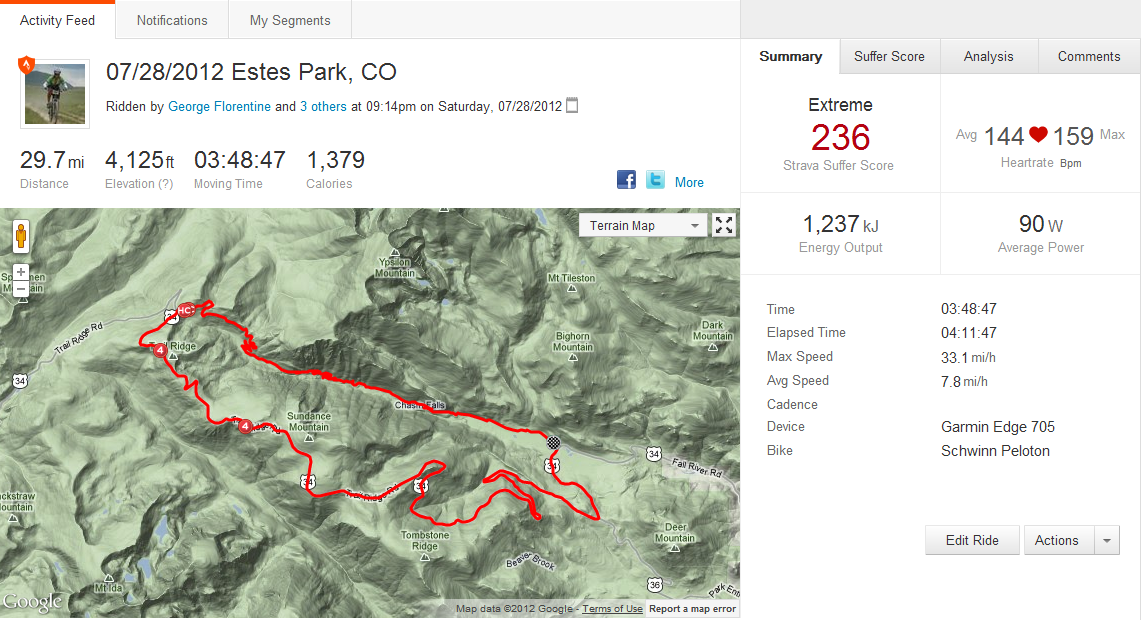
For me, the answer is: YES! I do want to push my body as hard as it can go. NO! I do not want to sit around and watch sunsets and be afraid that the slightest physical exertion will cause some strange, unpredictable catastrophic failure in my now slightly beat up body. So earlier this summer, I did climb up Fall River Road on my mountain bike. At night. Under the full moon. To the top of Trail Ridge Rd - 12,200 ft. And then a screaming descent. 30 miles, 4,200 ft of climbing. And I was dead last every foot of the way. My companions were very supportive of me - making sure I didn't have a break down, riding up, riding back, waiting for me. And it was HARD. 3+ hours with my heart rate > 150 bpm, which for my age is pretty much rockin'.
As I collapsed in the car after the ride, I wondered. How many adults, cancer survivors or not, actually do something like this. Challenge themselves to a maximum intensity workout? Push yourself so hard you break. Then you recover, push hard again. Break again. Your fingers are numb, your toes are tingling, you're getting woozy. Because you're at 11,000 ft, you're climbing a 10% grade and your hematocrit is 38? Not many, I wager. And what a loss for them. When you push yourself beyond what you think you can do, you give yourself a wonderful gift. And this gift is especially precious when it comes after your body has been so ravaged by a disease and the poisons and medieval torture we inflict as part of cancer treatments.
So my advice for every cancer survivor I meet will be this. Do a maximum intensity workout. Don't worry about pushing too hard. You're much, much stronger than you think you are. And to get stronger still, guess what? You have to push hard. It's just that simple. No hard work, no improvement. A pretty good life lesson, by the way. So I'm going to watch the pretty sunsets. But only after I've hammered myself on a bike, a run, a swim - something.
And finally, why do I love Strava? Because it's got the suffer score. This is based on your heart rate during a workout as a function of your max heart rate. So when everyone is ahead of you and you think to yourself "Yeah, I'm only in the 11th percentile of all Strava users that have climbed this segment. But I sure as hell am in the 99th percentile when it comes to working hard!!" Well, now Strava gives you quantitative support for your argument. So get a Strava account, punish yourself on some rides and then compare your suffer score against all those slacker, healthy guys and gals that were just coasting up the road ahead of you!
Here's my Strava segment for the Fall River Ride in July of 2012. Beat my suffer score and send me your Strava workout! cya on the road!!!
Subscribe to:
Posts (Atom)